

Continuous Bond vs. Single Transaction Bond

By Jacob Lee | Last Modified: May 29, 2026


Was this article helpful?
Explore even more resources at customsbondsusa.com
What is a Continuous Bond?
A continuous bond is an annual bond that covers multiple import entries for 12 months.
Instead of obtaining a single transaction bond for individual entries, a continuous bond allows all entries during the year to be covered under the same bond. It is the better option for frequent importers or businesses that import PGA-regulated goods.
Businesses that commonly use continuous bonds are:
- Manufacturers
- Wholesalers
- Large ecommerce sellers
Continuous bond example:
An importer runs a mid-sized Italian restaurant in New York City. The restaurant imports bulk baked goods and meats from Italy each month for its menu. Since these imports are frequent and in large volumes, the importer benefits from a continuous bond instead of applying and paying for individual bonds for each shipment.
What is a Single Transaction Bond?
A single transaction bond is a bond that covers one entry. Importers who ship fewer than three times a year use single transaction bonds to reduce bond costs while maintaining customs compliance.
Businesses that commonly use single transaction bonds are:
- Small retailers
- Ecommerce sellers testing new products
Single transaction bond example:
A boutique furniture retailer in Atlanta imports a single container of handmade dining tables from Italy valued at $40,000. Because this is the company’s only international shipment for the year, the importer purchases a single transaction bond instead of a continuous bond. The bond guarantees CBP will receive payment of any duties, taxes, and fees tied to that specific entry.
How Does CBP Calculate Customs Bond Amounts?
CBP sets continuous bonds at 10% of total duties, taxes, and fees paid by an importer during the previous 12-month period, with the minimum bond amount set at $50,000.
Single transaction bonds are equal to the total value of the goods, plus duties, taxes, and fees. The minimum bond amount is $100, unless law or regulations allow for a lesser amount.
Merchandise Processing Fees (MPF) and Harbor Maintenance Fees (HMF) are included in the fees for both bonds. An MPF is a processing fee CBP charges at 0.3464% of the cargo’s total value. An HMF is a fee charged on ocean imports at 0.125% of cargo’s total value.
Continuous Bond Amount Example Calculation
A U.S. importer paid the following amounts to CBP over the past 12 months:
- Duties: $320,000
- MPF: $18,000
- HMF: $12,000
To find their continuous bond amount, the importer must add up their expenses.

Next, the importer must multiply the $350,000 by 10%, which equals $35,000. Since this amount is below CBP’s minimum threshold, the importer’s bond will cost $50,000.
Single Transaction Bond Amount Example Calculation
A U.S. importer is bringing in a shipment of commercial espresso machines from Italy.
- Declared cargo value: $85,000
- Estimated duties: $4,250
- MPF: $485
- HMF: $106
To find their continuous bond amount, the importer must add up their expenses.
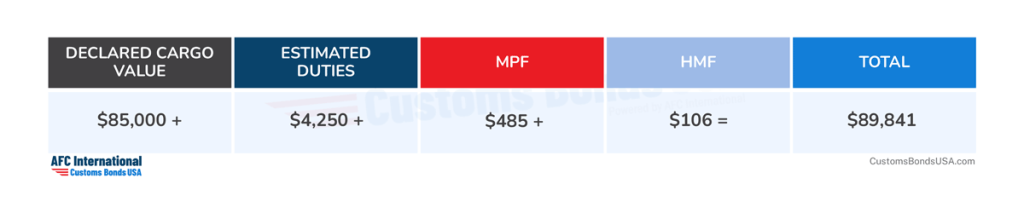
Bond providers typically round up bond amounts to the nearest bond tier to avoid bond insufficiency, so the importer will pay $90,000.
How Do I Get a Continuous or Single Transaction Bond?
CBP requires importers to complete CBP Form 301 and obtain their bond from a licensed customs broker, surety company, or freight forwarder. Regardless of which you’re applying for, follow these steps to complete your bond set up.
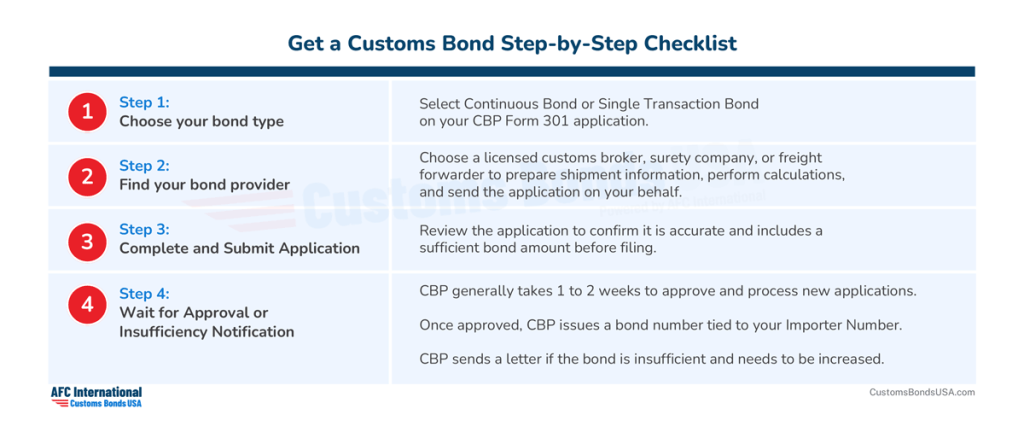
All new applications are filed via email to CBP’s Surety Bonds & Accounts Team.
Do I Need a Customs Broker to Obtain a Bond?
CBP does not require importers to hire a customs broker to obtain a customs bond.
Importers can obtain a bond through a freight forwarder or surety. However, purchasing a bond from a broker is often the easiest method. A customs broker is an individual or company licensed and regulated by CBP to help importers comply with federal requirements.
Importers who partner with customs brokers are able to:
- File and submit sufficient CBP bonds
- Pay duties and customs fees for compliance
- Streamline customs clearance
When you hire a licensed customs broker, they can help manage bond filing and related customs processes on your behalf.
How Should Importers Choose Between a Continuous Bond and a Single Transaction Bond?
Importers should choose a continuous bond when they expect recurring entries over a 12-month period, or they should choose a single transaction bond when they only need coverage for one shipment or occasional imports.
The right choice depends on shipment frequency, regulatory requirements, and total duty exposure. Compare each bond type to find the one that fits the needs of your shipment.
Check whether your import requires a customs bond before you move forward. Call our team at (480) 725-3433 and we’ll help you choose the best bond for your import plans.
Sources:
Bonds – Types of bonds, CBP, 2026
Bonds – How are Continuous and Single Entry bond amounts determined?, CBP, 2026
Customs User fee – Merchandise Processing Fees, CBP, 2026
What is The Harbor Maintenance Fee (HMF)?, CBP, 2025
CBP Form 301 – Customs Bond, CBP, 2025