
Customs Bond Requirements


Customs bond requirements determine whether an importer needs a bond, which type may be appropriate, and what information must be provided before goods can clear customs.
The requirements often depend on:
- Shipment value
- Type of goods
- Import frequency
- Partner Government Agency requirements
- The importer’s compliance and import history
Understanding these requirements early can help importers avoid clearance delays, unexpected costs, and last-minute problems.
When is a Customs Bond Required?
U.S. Customs Border Protection generally requires a customs bond when imported merchandise is valued over $2,500.
A bond may also be required when goods are regulated by a Partner Government Agency, even when the shipment value is below $2,500.
Partner Government Agencies may regulate products such as:
- Food
- Medical devices
- Pharmaceuticals
- Agricultural products
- Vehicles
- Chemicals
- Consumer products
The bond helps ensure that the importer will meet applicable obligations, including paying duties, taxes, and fees and complying with U.S. import regulations.
If a required bond is not in place, CBP may not release the goods.
The best time to address bond requirements is before the shipment arrives. Importers should confirm whether a bond is needed, choose the appropriate bond type, and gather the required information before a delay occurs.
How Import Activity Affects Bond Requirements
Import frequency, shipment value, and product type can all affect which customs bond an importer needs.
The two primary options are:
Single Transaction Bond
A Single Transaction Bond generally covers one customs entry or shipment. It may be appropriate for importers who:
- Import infrequently
- Need coverage for one shipment
- Are not yet importing on a regular basis
The shipment value and estimated duties, taxes, and fees are used when determining the required bond amount.
Continuous Bond
A Continuous Bond generally covers multiple import transactions during a 12-month bond term. It may be appropriate for importers who:
- Import regularly
- Expect to make multiple entries
- Want one bond covering ongoing import activity
A Continuous Bond may be more practical and cost-effective for frequent importers than purchasing separate bonds for individual entries.
Customs Bonds USA, powered by AFC International, provides Continuous Bonds to importers.
Who Must Meet Customs Bond Requirements?
Customs bond requirements generally apply to the party acting as the Importer of Record, or IOR.
The Importer of Record is responsible for ensuring that imported goods comply with U.S. laws and that required duties, taxes, fees, and documentation are addressed.
The IOR may be:
- The owner of the goods
- The purchaser of the goods
- The consignee receiving the goods
- A licensed customs broker acting on behalf of another party
In most cases, the importer should confirm who will act as the IOR before the goods are shipped. This helps prevent confusion over who is responsible for the bond, customs entry, and supporting documentation.
Learn more about who needs a customs bond and how an IOR supports importing activity.
What Do Sureties Require Before Issuing a Customs Bond?
A customs bond typically involves three parties:
- The importer, or principal, who is responsible for meeting the bond’s conditions
- U.S. Customs and Border Protection, which requires the bond
- The surety company, which financially backs the bond if the importer does not meet its obligations
Importers do not always work directly with the surety. They may obtain a bond through a licensed customs broker or bond provider that works with an authorized surety company.
Customs Bonds USA is powered by AFC International, a licensed customs brokerage. AFC International helps importers obtain the appropriate bond and submit the required information, while the surety company provides the financial backing for the bond.
Before issuing a bond, the surety may review information about the importer, the shipment, and the requested bond coverage. This helps the surety evaluate risk, confirm the correct bond type, and determine whether the bond amount is sufficient.
Sureties commonly request:
- Legal business name
- Business address and contact information
- Employer Identification Number, Social Security number, or CBP-assigned importer number
- Requested bond type
- Requested bond amount
- Description of the imported goods
- Shipment value
- Estimated duties, taxes, and fees
- Country of origin
- Port of entry
- Customs broker information, when applicable
- Import history, particularly for Continuous Bonds
- Information about goods regulated by Partner Government Agencies
CBP Form 301 is the standard customs bond form and includes fields for identifying the bond type, the bond amount, the principal, and the surety.
A surety may request additional documentation when:
- The importer is new
- The shipment presents higher compliance risk
- The requested bond amount is large
- The goods are subject to additional agency requirements
- The importer has a limited or complex import history
Importers should provide complete and accurate information. Missing or incorrect details can delay bond approval, customs clearance, or cargo release.
What Happens If Bond Requirements Are Not Met?
Failing to meet customs bond requirements can create immediate problems in the import process.
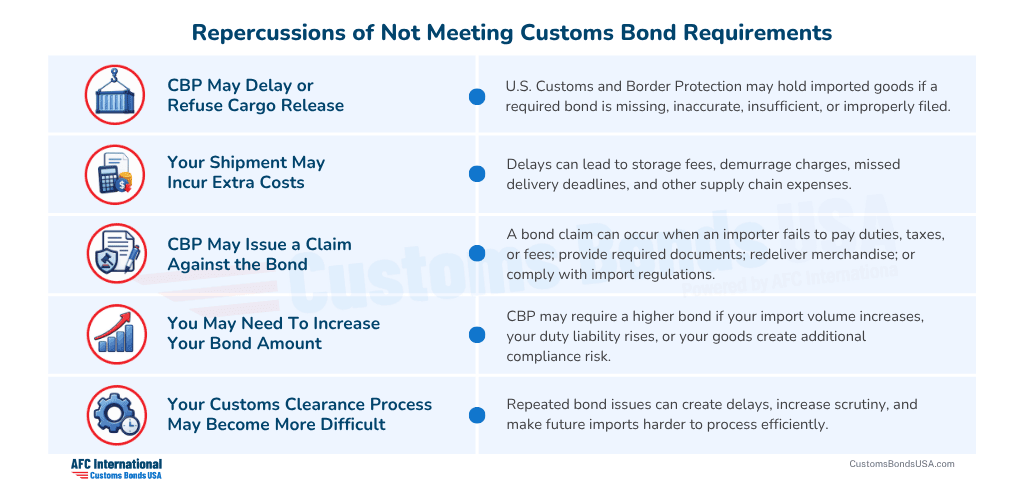
Possible consequences include:
- Delayed customs clearance
- Delayed cargo release
- Incomplete customs filings
- Additional storage or handling costs
- Last-minute bond applications
- Requests for additional documentation
- Bond insufficiency issues
- Disruptions to future imports
A customs bond should not be treated as a final administrative step after the shipment is already moving.
Importers are better positioned when they confirm the bond requirement, choose the correct bond type, and provide the necessary information before the shipment reaches a port of entry.
You can also call our team at (480) 725-3433 for guidance and additional information about customs bonds.
Sources:
Partner Government Agencies Import Guides, CBP, 2026
When Is a Customs Bond Required, CBP, 2026
CBP Form 301 – Customs Bond, CBP, 2025
Employer Identification Number, Internal Revenue Service, 2026