


Customs Bond Costs


Customs bond cost usually depends on bond type, bond amount, annual duty exposure, and surety underwriting. Many importers pay a few hundred dollars per year for a standard continuous bond, while single-entry bonds cost less upfront but can cost more overall if you import multiple times each year.
How Much Do Customs Bonds Usually Cost?
Most customs bonds cost a small percentage of the required bond amount rather than the full amount. A standard continuous bond often costs a few hundred dollars annually, while single-entry bond pricing varies by the total value of the goods, plus duties and fees.
In general, customs bond pricing depends on:
- The type of bond you need
- The required bond amount
- Your annual import volume
- Your estimated duties, taxes, and fees
- Your company’s import history
- The surety’s underwriting review
A single-entry customs bond usually costs less upfront because it covers only one shipment. However, single-entry bond costs can add up quickly if you import multiple times per year. A continuous customs bond often becomes more cost-effective when an importer brings goods into the United States regularly.
What Affects the Cost of a Customs Bond?
Several factors influence customs bond pricing. The most important cost drivers include bond type, bond amount, import activity, risk profile, and surety requirements.
Bond Type
The type of customs bond affects the price because each bond covers a different level of import activity.
The two most common options are:
- A single transaction bond is a bond that covers one import transaction.
- A continuous bond is a bond that covers multiple import transactions over a 12-month period.
Importers often choose a single-entry bond for occasional shipments. Frequent importers usually choose a continuous bond because one annual bond can cover multiple entries.
Bond Amount
The bond amount is the coverage limit required by Customs and Border Protection (CBP). The bond cost is the premium paid to purchase that coverage.
For many importers, the minimum continuous customs bond amount is $50,000. Some importers need a larger bond if their annual duties, taxes, and fees exceed certain thresholds.
A larger bond amount can increase the premium because the surety accepts more financial exposure.
Import Volume and Duty Exposure
Import volume affects customs bond cost because frequent importing creates more opportunities for duties, taxes, penalties, or compliance issues during the bond term.
Duty exposure also matters. Importers with higher annual duties, taxes, and fees may need higher bond amounts.
Cost can increase when an importer has:
- Frequent shipments
- High-value goods
- High-duty products
- Large annual duty payments
- Antidumping or countervailing duty exposure
- Regulated goods that require additional agency oversight
For example, higher annual duty payments can trigger a larger required bond amount, which usually increases the annual premium.
Surety Underwriting Requirements
A surety is the company that guarantees payment to CBP if the importer fails to meet covered obligations.
Sureties may review several factors before issuing a bond, including:
- Business credit
- Financial strength
- Import history
- Commodity type
- Annual duty exposure
- Prior claims
- Compliance history
- Need for collateral
Some importers can buy a standard customs bond quickly. Other importers may need additional documentation, collateral, or a higher premium if the surety sees greater risk.
What’s the Difference Between Bond Cost and Bond Amount?
Customs bond cost and customs bond amount are not the same.
The customs bond amount is the coverage limit required by CBP. For example, a $50,000 continuous bond means the surety provides up to $50,000 in bond coverage for covered obligations.
The customs bond cost is the premium the importer pays to buy the bond. That means an importer might pay several hundred dollars per year for a $50,000 continuous bond, depending on the provider and underwriting requirements.
Here is the simple difference:
- Bond amount: The coverage limit.
- Bond cost: The price paid for the bond.
- Bond premium: Another term for the cost paid to purchase the bond.
- Surety exposure: The financial risk the surety accepts.
Think of the bond amount as the coverage limit and the bond cost as the purchase price.
What Should You Compare Before Buying a Customs Bond?
Before buying a customs bond, compare more than the quoted price. A low premium may not be the best option if the provider does not help you choose the right bond type or bond amount.
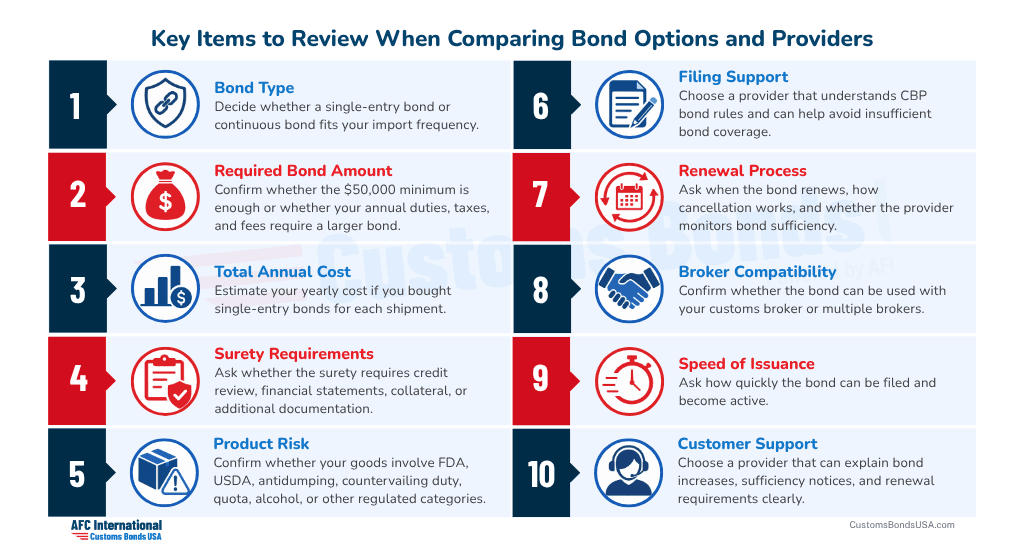
For the most accurate quote, calculate your expected import activity and estimate your annual duties, taxes, and fees. Then compare the total cost of single-entry coverage against an annual continuous bond.
Explore your customs bond options based on your import activity, or call (480) 725-3433 to speak with someone about the right bond for your needs.