

How to Avoid Customs Bond Insufficiency



By Jacob Lee
Last Modified:
May 29, 2026

Was this article helpful?
Explore even more resources at customsbondsusa.com
Customs bond insufficiency happens when a bond no longer meets the amount required by CBP, and this guide helps businesses understand what causes a bond to become insufficient, what happens after a CBP insufficiency notice, and how to maintain enough coverage to avoid delays, cargo holds, and added bond requirements.
Customs bond insufficiency is when an importer’s bond no longer covers the duties, taxes, and fees required by U.S. Customs and Border Protection (CBP). When that happens, CBP may require a bond increase or other corrective action before future entries can be processed without added bond-related delays.
What is an Insufficient Customs Bond?
An insufficient customs bond is a bond amount that no longer meets CBP’s required coverage. When the bond falls short, the importer must replace the bond with a new one that meets the required coverage.
For example, an importer with a $50,000 continuous bond increases annual duty payments to $900,000. Because CBP requires continuous bonds to equal 10% of annual duties, taxes, and fees, the importer may need a $90,000 bond to remain compliant.
CBP will require the importer to either increase the bond amount, replace the insufficient bond, or submit a bond rider under 19 CFR § 113.24 to remedy bond insufficiency.
The most common CBP bond types are single transaction bonds (STB) and continuous bonds (CB). With both bond types, CBP sets a required amount to guarantee payment of import fees.
- For a single transaction bond: The bond amount is 100% of the entry value, duties, and fees. This bond has a minimum set at $100.
- For a continuous bond: The bond amount is 10% of total duties, taxes, and fees paid by the importer during the previous 12-month period. This bond has a minimum set $50,000.
Common reasons bond amounts are insufficient are:
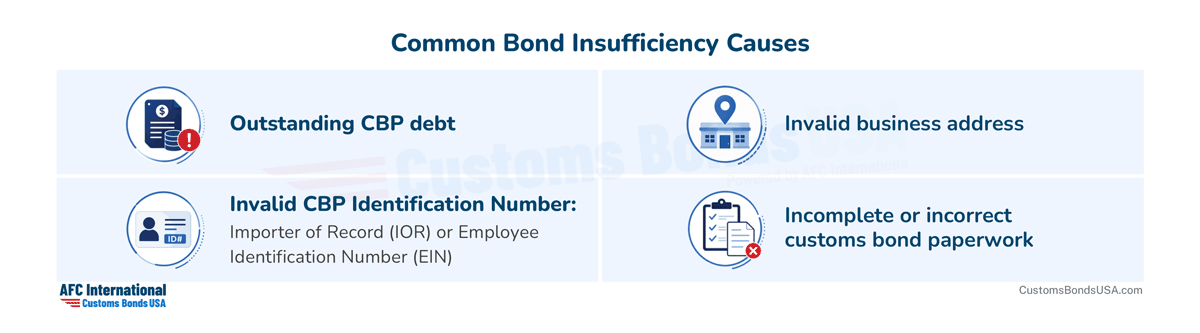
CBP may also determine a customs bond as insufficient when importers do not deposit the required cash-in-lieu of surety for continuous bonds under 19 CFR § 113.40.
What Happens When CBP Sends Me a Bond Insufficiency Letter?
CBP sends a bond insufficiency letter when your current bond no longer covers required duties, taxes, and fees. In most cases, the importer must terminate their old bond and provide a new one that meets the required amount.
CBP may also require a cash deposit on future shipments to remedy the insufficient bond on file, or single transaction bond for importers with a continuous bond.
If the importer does not correct the bond amount within 15 days, CBP holds the importer’s goods without release until the bond is made sufficient. CBP may suspend the importer’s ability to clear cargo under the existing bond.
How Importers Can Maintain Sufficient Customs Bond Coverage
Importers can maintain sufficient customs bond coverage by matching their bond amount to current duty exposure, keeping importer information accurate, and providing complete shipment details.
We’ve created a graphic to illustrate how to maintain customs bond sufficiency and stay in CBP compliance.
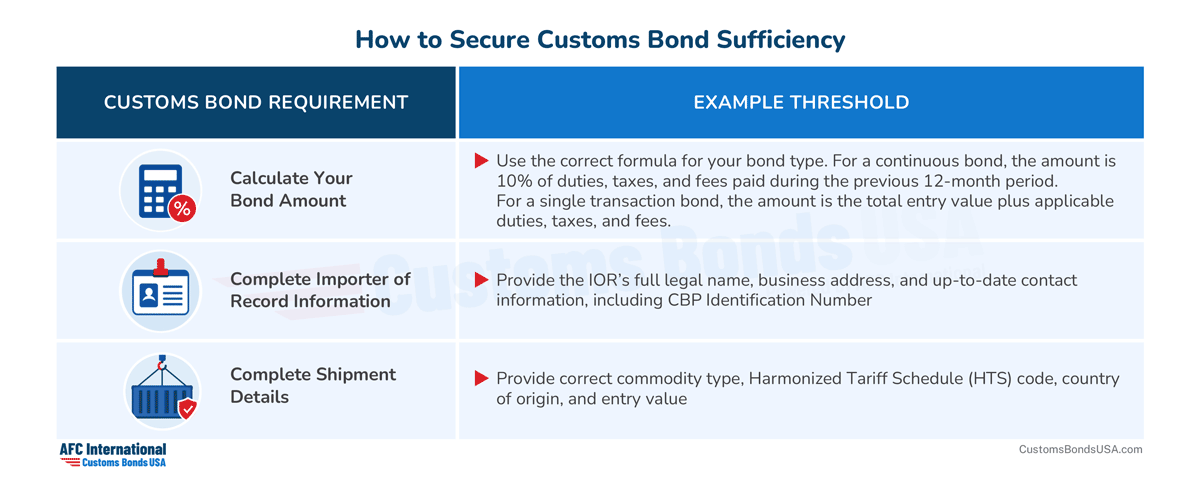
When CBP determines a bond amount is insufficient, the importer must obtain a higher bond amount or file a new bond application with the corrected amount within 30 days under 19 CFR § 113.11(b)(2).
Importers use bond riders to amend the terms of their existing bond. These amendments are generally for duty recalculation to meet CBP bond amount requirements.
19 CFR § 113.3 states for terminated bonds, CBP still holds importers and their surety provider accountable for any obligations under that bond. No entries will be allowed under an insufficient bond.
Why a Customs Bond Becomes Insufficient
Customs bond insufficiency is caused by bond amounts that no longer match import activity, unpaid CBP debt, incorrect importer information, or incomplete bond paperwork. Higher duties, taxes, fees, or shipment volume can also make an existing bond insufficient.
Bond Amount Does Not Match Import Volume
Importers must calculate bond coverage based on projected duties, taxes, and annual shipment volume.
For continuous bonds, CBP sets the minimum bond amount at $50,000. However, if your import shipments and duty obligations increase beyond the minimum, you are required to increase your bond amount to match.
Importer Owes Money to Customs and Border Protection
CBP-related debts affect the importer’s current bond. If importers owe on CBP claims made on previous bonds for unpaid duties or haven’t paid past bond amount increases, the debt will be applied to the importer’s new bond and remain insufficient until paid.
Importer Has Multiple Customs Bonds
While CBP does not prohibit the amount of active customs bonds an importer can have, bond stacking complicates importing with higher costs and regulatory compliance issues.
If you or your logistics team are running into bond sufficiency complications, a licensed customs broker can help prevent bond application errors and reduce compliance risk.
When your import activity changes, review your bond amount before your next filing cycle. A licensed customs broker can help you verify your exposure, correct bond issues, and prevent avoidable release delays.
Contact our team at (480) 725-3433 for help reviewing your current bond coverage.
Sources:
19 CFR § 113.13(c) – Periodic review of bond sufficiency
19 CFR § 113.24 – Bond Riders
Bonds – Types of bonds, Customs and Border Protection
19 CFR § 113.40 – Acceptance of cash deposits or obligations of the United States in lieu of sureties on bonds.
19 CFR § 113.11(b)(2) – Application Updates.
19 CFR § 113.3 – Liability of surety on a terminated bond.