

How to Apply for a Continuous Customs Bond




By Jacob Lee
Last Modified:
May 29, 2026

Was this article helpful?
Explore even more resources at customsbondsusa.com
How Do You Apply for a Continuous Bond?
Importers can apply for a continuous bond by working with a licensed customs broker or surety provider to obtain a customs bond and submit CBP Form 301 to Customs and Border Protection. Importers must confirm their business and contact information, bond amount, and application details before submission.
Continuous bonds are for importers who:
- Ship more than three times a year
- Import goods valued at $2,500 or more per entry
- Import commodities regulated by Partner Government Agencies (PGA)
According to CBP customs bond regulatory guidance under 19 CFR 113.11(b), continuous bonds must be sufficient to cover estimated yearly duties and fees.
Use these steps to complete your continuous bond application and meet CBP bond requirements.
Step 1: Find Your Bond Provider
Bond providers underwrite the financial terms of a bond to determine appropriate coverage. You can obtain a bond through a:
- Customs broker
- Surety company
- Freight forwarder
Using a licensed customs broker to obtain a continuous bond is the easiest and most common method used by importers.
Customs brokers act as an agent for a surety company and handle the application process for you. You can also work directly with a surety company that’s licensed by the U.S. Department of the Treasury.
Step 2: Calculate Continuous Bond Amount
Continuous bond amounts are 10% of the total taxes, duties, and fees paid in a 12-month period, with a minimum bond amount of $50,000. CBP determines the bond amount based on this formula to guarantee bond sufficiency.
Bond sufficiency is when the bond amount adequately covers all import fees to clear goods. CBP reviews bond amounts periodically and notifies importers of bond insufficiency. If this happens, CBP allows importers 15 days to correct the bond amount.
Step 3: Fill Out and Sign Power of Attorney (POA)
If a customs broker or surety will file the bond on your behalf, you will need to complete a Power of Attorney (POA). This document authorizes the filer to handle customs and bond paperwork for your business.
A POA typically includes:
- Legal name or business name
- Employer Identification Number (EIN), Social Security Number (SSN), or Customs Assigned Importer Number (CAIN), if applicable
- Phone number and email address
- Business address
- State of residence or incorporation
- Jurisdiction where the business operates
After completing the required information, sign the POA so the authorized party can submit bond-related documents for you.
Step 4: Complete CBP Form 301
Importers must fill out and complete CBP Form 301 to apply for a continuous bond.
CBP Form 301 requires the following importer and shipment information:
- Importer of Record (IOR) Legal Name
- IOR Contact Information (Phone Number and Email Address)
- Business Name and Physical Address
- Payment Information
- Entry Details (Value, Country of Origin, and Commodity)
- CBP Identification Number
- Execution Date
The bond application also requires an activity code that matches import activity and bond coverage. Continuous bonds typically use Activity Code 1 (Importer Bond).
Step 5: Review and Submit Application
Before you submit your continuous bond application, ensure all CBP Form 301 fields are complete with accurate information to avoid bond insufficiency or submission rejection.
Review and sign your bond to file with CBP’s Surety Bonds & Accounts Team. If you’ve hired a Licensed Customs Broker or surety company to issue the bond and file the application for you, review your POA to ensure all information is correct.
What Documents and Information Do You Need?
To file your CBP bond, you will need the following documentation:
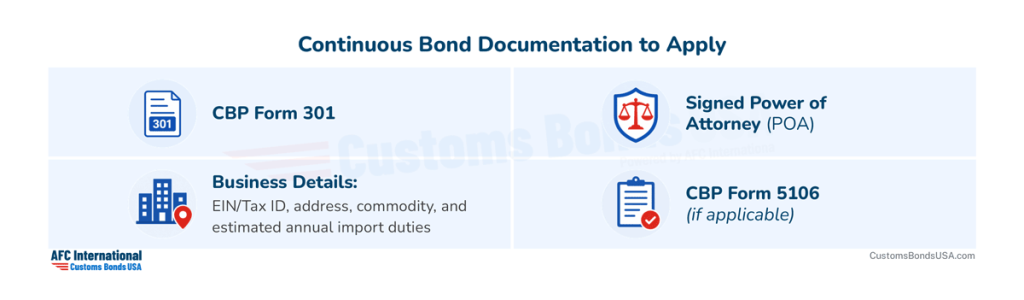
Only use CBP Form 5106 to update your importer identification information with CBP. This is necessary if your business name or address has changed.
What Happens After My Application Is Submitted?
Once you submit your customs bond application, your bond provider will underwrite, approve, and issue your bond request. For high bond amounts, you may need to provide additional financial documentation, like tax returns or bank statements, before approval.
According to CBP bond guidance, import bond applications are processed within one to two weeks. Once the surety approves the bond, CBP charges an annual bond fee and issues a bond number to tie to the importer’s IOR number in CBP systems.
If the importer has given POA to the bond provider, the company will manage all customs bond approvals and payments on the importer’s behalf.
Even if you work with a customs broker, be sure to keep a copy of your bond number, surety information, and any CBP-related documentation pertaining to your bond for your records.
How Much Does a Continuous Bond Cost?
A continuous bond costs an annual premium based on the bond amount, the importer’s risk profile, and the surety’s underwriting terms.
The cost can vary based on the following:
- The bond provider’s underwriting fee and risk assessment
- The bond amount required by CBP
- The importer’s annual import volume and commodity type
CBP may require a higher bond amount based on duty exposure, shipment frequency, and import risk.
Continuous Bond Cost Example: If your estimated annual duties, taxes, and fees total $620,000, your continuous bond amount would typically be $62,000. If your total is below the minimum threshold, the bond amount is set at $50,000.
What Mistakes Delay a Continuous Bond Application?
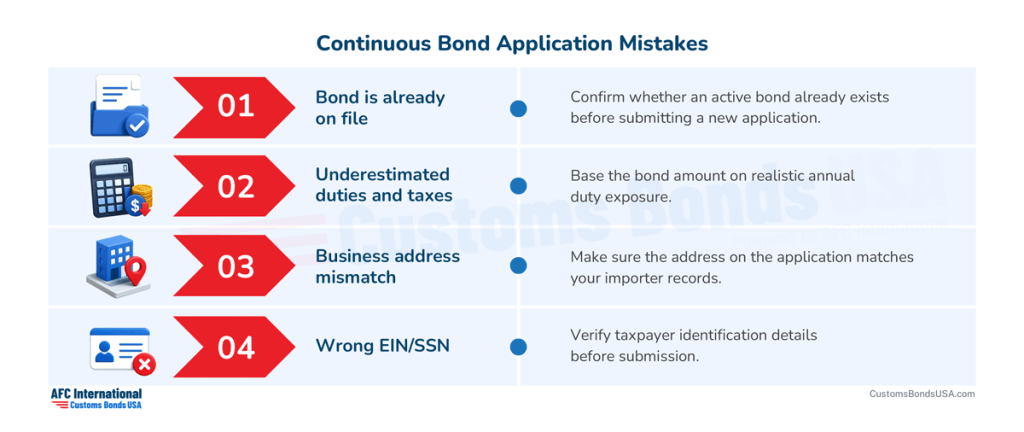
The most common continuous bond application mistakes are incorrect importer details, underestimated duty exposure, mismatched business information, and missing authorization documents.
We’ve created a chart of common mistakes importers make when applying for a continuous bond.
If you’re unsure if your import volume requires a continuous bond or need help with your CBP Form 301 application, call our team at (480)-725-3433 for more information.
Sources:
19 CFR 113.11(b) – Continuous bond application
CBP Form 301 – Customs Bond, CBP
General Guidelines for Completing the CBP Form 301 for Continuous Bonds – Activity Code 1, CBP, 2013
CBP Form 5106 – Create/Update Importer Identity Form, CBP
Bonds – How to obtain a Customs Bond, CBP