
How to Get a Customs Bond



By Jacob Lee
Last Modified:
May 29, 2026

Was this article helpful?
Explore even more resources at customsbondsusa.com
A customs bond is a contract required by U.S. Customs and Border Protection (CBP) for imported goods valued over $2,500 and regulated by Partner Government Agencies (PGA). It guarantees importers will abide by applicable regulations and pay all duties, taxes, and fees. To get a customs bond, importers choose a bond type, work with a customs broker or surety provider, complete CBP Form 301, and submit the bond for approval to clear customs.
How Importers Apply for a Customs Bond
Before applying for a customs bond, importers need to choose the right bond type, decide which provider to work with, and gather required information for CBP Form 301. Taking these steps early helps prevent filing errors, approval delays, and noncompliance at customs entry.
1. Choose the Right Bond Type
Select your bond type on CBP Form 301. The two primary types of CBP bonds are continuous bonds and single transaction bonds.
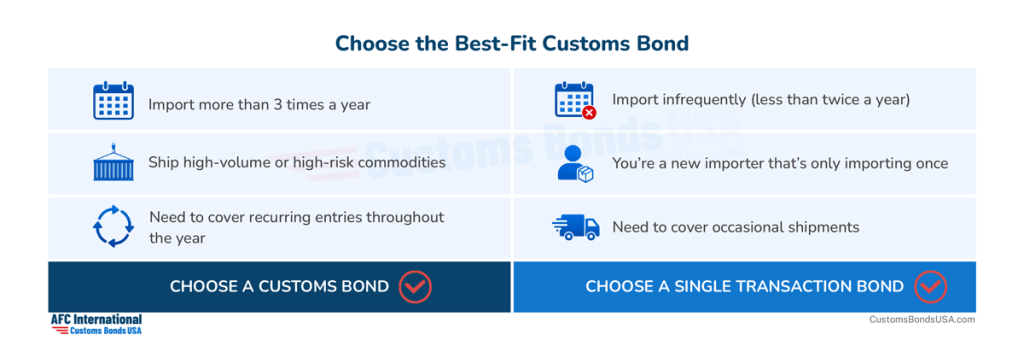
A continuous bond is an annual bond that covers fees and duties on multiple shipments for a 12-month period before automatic renewal. A single transaction bond covers federal import obligations for one shipment and does not renew.
Not sure which bond type you need? Use our quick-chooser guide to select the right one:
Avoid common mistakes such as entering the inaccurate declared value, choosing the wrong bond type, or filing too close to the entry date.
CBP will not release imported goods upon entry until your bond is submitted and approved with the correct bond type.
2. Choose a Customs Broker or Surety Provider
Select a bond provider to purchase your surety bond. Importers have three bond provider options:
- Licensed Customs Broker: A customs broker is a licensed individual or company who offers customs clearance guidance, often handling paperwork, payments, and CBP bond applications on their behalf.
- Surety Company: A surety company is a business that specializes in providing surety bonds. The Bureau of the Fiscal Service’s surety bond program lists approved sureties whom you can purchase bonds from.
- Freight Forwarder: A freight forwarder is an individual or company who coordinates freight transportation on behalf of an importer, including providing surety for international shipments.
While CBP does not require importers to hire a customs broker, brokers are licensed and regulated with CBP to assist importers with customs processes.
3. Complete CBP Form 301
Complete the required fields on CBP Form 301, including the following information:
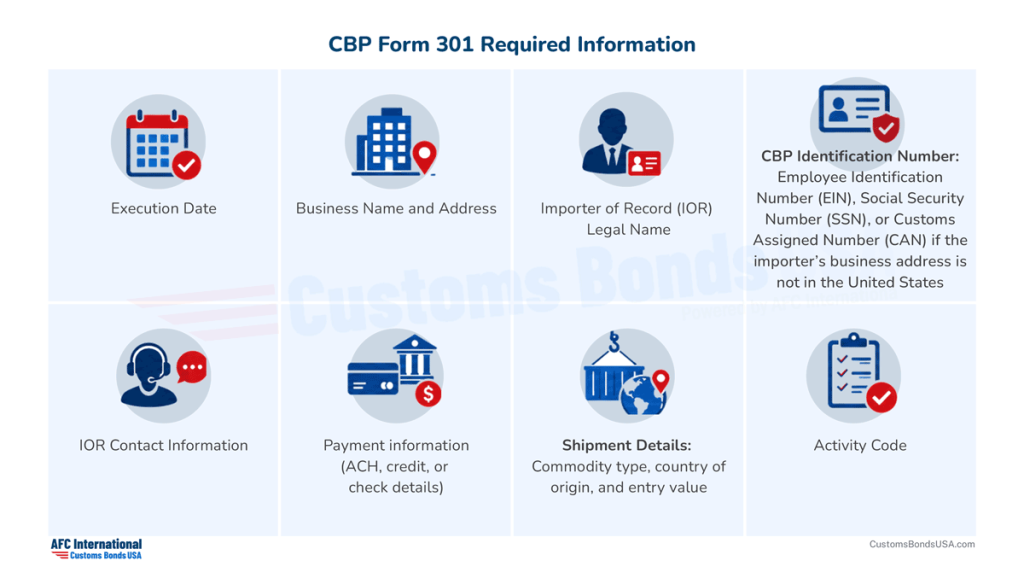
An activity code is a numerical identifier CBP uses to classify the purpose and coverage of a customs bond. Activity Code 1 (Importer Bond) is the most common code for continuous and single transaction bonds.
4. Submit CBP Bond and Wait for Approval
Review the bond information for accuracy, then complete and sign a Power of Attorney (POA) form if your bond provider will also file the bond on your behalf.
A Power of Attorney (POA) is a legal document that allows an individual or company to act on your behalf. Your customs broker, surety company, or freight forwarder can act as your POA and file your bond application to CBP. Paper applications and submissions are not permitted by CBP.
CBP does not require importers to work with a broker for bond applications, but importers must file a bond application to protect federal revenue under the 19 CFR § 113.11
CBP will not release goods unless importers secure a bond to cover import charges.
What Mistakes Delay Customs Bond Approval?
Importers risk bond application rejections when the following information is incorrect or missing on a CBP Form 301:
- A bond is already on file
- The importer has been voided in the CBP system
- Wrong EIN
- Duties underestimated
- Wrong activity code
- Insufficient bond amounts
CBP may require documents such as your business’s financial statements, surety application, or CBP Form 5106 to complete your application.
CBP Form 5106 is used to gather or update an importer’s identification information to import goods into the United States.
How Long Does It Take to Get Approved?
According to CBP’s guidance on obtaining a bond, applications take between one and two weeks for approval. This process includes ensuring the bond sufficiently covers import activity.
Bond insufficiency happens when a bond does not provide adequate coverage for an importer’s estimated entry costs. Bond sufficiency is reviewed by CBP through its Revenue Division Bond Team.
If your bond amount is too low to cover your shipment, CBP allows importers 30 days to file a correction with a new bond application.
If CBP approves the application, importers pay a bond fee and the bond provider issues the surety. The bond fee is either an annual premium for continuous bonds or a premium rate per shipment for single transaction bonds.
To check the status of your bond application, importers can contact their bond provider or email CBP’s Surety Bonds & Accounts Team.
Can You Have Multiple Customs Bonds?
CBP allows importers to have multiple active customs bonds, which is called bond stacking. This happens when an importer obtains a new bond before the liquidation of their goods under a previous one.
While bond stacking is allowed by CBP, it should be avoided by importers. Stacking your bonds can lead to compliance complications and additional import costs.
How Much Does a Customs Bond Cost?
CBP determines bond amounts in the following ways:
- For continuous bonds: Continuous bonds are 10% of total duties, taxes, and fees within a 12-month period, with a minimum bond amount set at $50,000.
- For single transaction bonds: Single transaction bonds are the total entry value plus customs fees, taxes, and duties.
Single transaction bond amounts cannot be less than $100 unless a lesser amount is allowed by law or applicable regulations.
To get a customs bond, importers need the appropriate bond type, accurate filing information, and adequate lead time for approval. Handling these details early reduces delays, prevents bond issues, and streamlines customs clearance.
If you’re ready to get your bond, then navigate to our service page to pick out the bond that’s right for you.
Sources:
Bonds – Types of bonds, CBP, 2026
Bonds – How to obtain a Customs Bond, CBP, 2026
19 CFR 113.11, Bond Application
Bonds – How are Continuous and Single Entry bond amounts determined?, CBP, 2026