

Customs Bond Requirements Checklist for New Importers



By Jacob Lee
Last Modified:
May 29, 2026

Was this article helpful?
Explore even more resources at customsbondsusa.com
When is a Customs Bond Required?
CBP requires importers to file a customs bond for commercial imports valued at $2,500 or more, or for commodities that are regulated by other federal agencies.
Customs bonds guarantee the importer will:
- Pay customs duties, taxes, and fees
- Comply with CBP customs regulations
- Reduce customs fraud and expedite customs clearance
We’ve created a chart that illustrates common commodities regulated by other government agencies that must be accompanied by a customs bond.
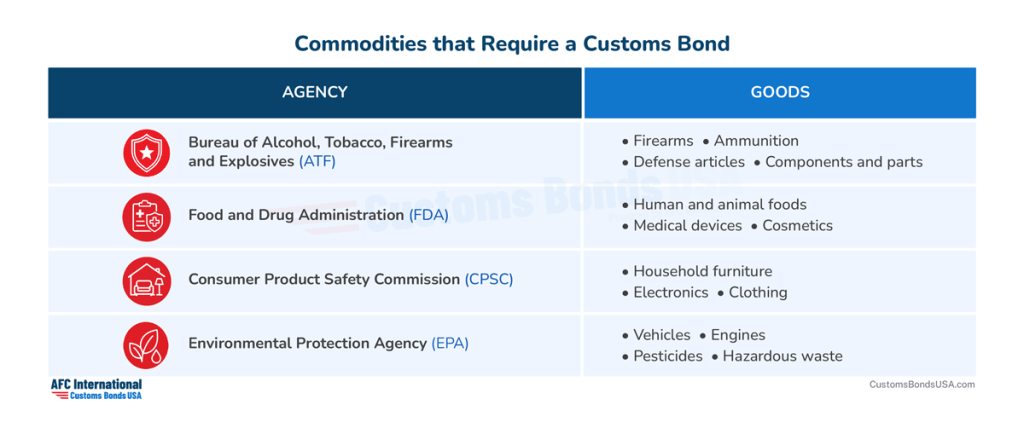
CBP enforces laws for other federal agencies at the port of entry. Therefore, imports regulated by Partner Government Agencies (PGA) will need a customs bond before arrival.
Customs bonds are a three-party contract that include:
- The Principal: The principal is the importer or party responsible for importing goods into the United States.
- The Surety: The surety is a licensed firm that provides bonds. They can be an insurance company or federal organization, like the Bureau of the Fiscal Service.
- The Obligee/Beneficiary: The obligee or beneficiary is CBP.
Importers who need customs bonds must list their business, business type, and imported commodity. Here are two common importing situations where a customs bond is needed.
Scenario One: A Commodity Subject to Federal Agencies
A U.S. meat manufacturer imports raw beef and poultry from Brazil to process into frozen meals sold in big box grocery stores.
The Food Safety and Inspection Service (FSIS) is an agency of the U.S. Department of Agriculture that regulates meat, poultry, and egg products. FSIS requires meat manufacturers to complete its eligibility application package for importing meat, poultry, and egg products after raw meat enters the U.S. through CBP.
A customs bond ensures this process goes smoothly and holds importers accountable for customs compliance.
Scenario Two: A Business That Imports Regularly
A car wholesaler imports automobiles from Japan each week. Since the imported shipments have a value above $2,500 and are regulated by the EPA and Department of Transportation (DOT), the wholesaler needs a customs bond to cover its weekly entries throughout the year.
What are the Requirements for Obtaining a Customs Bond?
To obtain a customs bond, new importers typically choose a bond type, a licensed customs broker or surety company, and complete an application with the bond amount and import details.
- Single transaction bond
- Continuous bond
A single transaction bond is a customs bond that covers a single entry. CBP requires importers to obtain this bond for individual import transactions valued over $2,500 each. While single transaction bonds do not renew, they are a great option for small businesses like online ecommerce sellers who import infrequently.
A continuous bond is an annual bond that covers multiple entries over a 12-month period. Continuous bonds automatically renew after 12 months or until they are cancelled by the importer or the surety. Importers who import regularly often use this bond to streamline customs clearance and simplify bond coverage for high import activity.
What Do You Need to Apply for a Customs Bond?
Use this checklist to gather the CBP forms and information to apply for a single transaction bond or continuous bond.
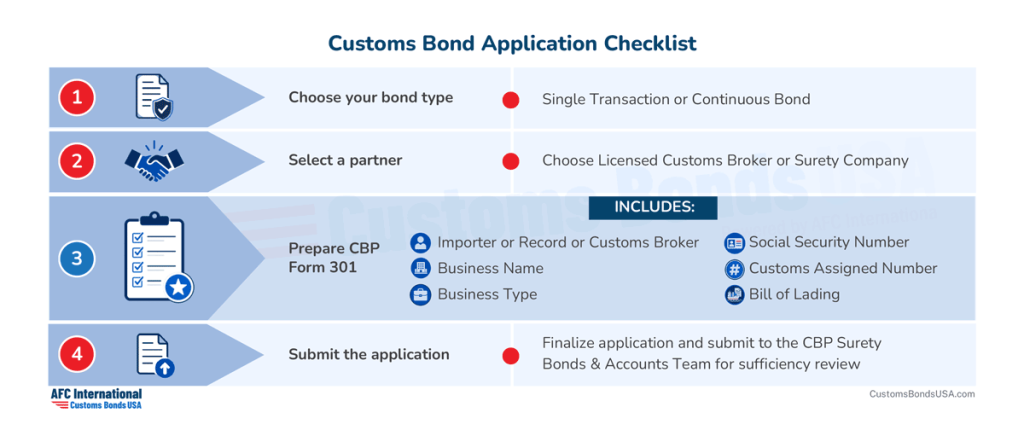
This checklist helps importers gather the information needed to complete a customs bond application and avoid bond insufficiency.
When is a Customs Bond Declared Insufficient?
Bond insufficiency occurs when an importer’s bond amount no longer covers the estimated customs fees for imported goods.
A continuous bond is insufficient when the bond amount is less than 10% of the total duties, taxes, and fees paid by an importer over the previous 12 months.
Single transaction bonds are insufficient when they are not equal to the total value of the goods, plus any duties, taxes, and fees.
Single Transaction Bond Requirements
Use this checklist to verify your bond meets CBP’s single transaction bond requirements:
- Bond amount must equal the entered value plus duties, taxes, and fees.
- Regulated or high-risk products like alcohol or tobacco may require up to three times the entered value.
- A new bond is needed for every shipment valued at more than $2,500.
While tariff rates may fluctuate due to changes in federal regulations, CBP customs bonds cannot be less than $100 unless federal laws allow a lesser amount.
Continuous Bond Requirements
This checklist verifies your continuous bond is sufficient and meets CBP requirements:
- New importers will need an Importer of Record Number (IOR), such as an Employer Identification Number (EIN) or Social Security Number (SSN).
- Minimum bond amount is $50,000 or 10% of the projected import taxes, duties, tariffs paid over the previous 12 months.
- Continuous bonds renew annually unless terminated, although the surety premium is commonly billed annually.
Importers using continuous bonds where bond coverage exceeds $50,000 must obtain a bond that matches the importer’s estimated liability. CBP reviews bond sufficiency annually and may require an increase in the bond amount.
New and small to mid-sized commercial importers who understand customs bond requirements are better positioned to choose the correct bond type, maintain sufficient coverage, and avoid compliance issues that delay customs clearance.
We’re here to help. Call (480) 725-3433 to review your bond application details before filing and reduce the risk of delays or insufficiency notices.
Sources:
When is a Customs bond required, CBP, 2026
Prohibited and Restricted Items, CBP, 2025
Surety Bonds, Bureau of the Fiscal Service, 2026
Importing Meat, Poultry & Egg Products to the United States, FSIS, 2024
Bonds – Types of bonds, CBP, 2026
19 CFR § 113.11 for bond application, 2015
Bonds – How to obtain a Customs Bond, CBP, 2026
Bonds – How are Continuous and Single Entry bond amounts determined?, CBP, 2026