

What is a Customs Bond?

Was this article helpful?
Explore even more resources at customsbondsusa.com

Written By Joe Weaver
Last Modified: May 14, 2026


Key Takeaways:
A customs bond is a financial guarantee that allows goods to clear U.S. customs by ensuring CBP can collect the duties, taxes, and fees owed on an import shipment, and this guide helps importers understand when a bond is required, how continuous and single transaction bonds differ, and what steps are involved in choosing and securing the right bond coverage.
Who Is Involved in a Customs Bond?
When Does CBP Require a Customs Bond?
What Are the Main Types of Customs Bonds for Commercial Importers?
When Is a Continuous Bond Better Than a Single Transaction Bond?
How Much Continuous Customs Bond Coverage Does an Importer Need?
What Other Bond Types Does CBP Recognize?
How Do You Get a Customs Bond?
Who Is Involved in a Customs Bond?
Simply put, a customs bond is an agreement between CBP, an importer, and a surety or customs broker that guarantees payment of duties and customs fees to CBP during the customs clearance process.
The three parties involved in a customs bond are listed below:
- The Importer of the Record (IOR)
- The importer’s surety company or customs broker
- CBP
Importantly, the customs bond guarantees that CBP receives customs duties and fees, and is not an insurance policy for the imported goods. CBP is the agency responsible for enforcing customs clearance regulations in the U.S.
When Does CBP Require a Customs Bond?
Per 19 CFR Part 113, importers need a customs bond on file when their commercial shipments are valued at over $2,500, the goods are regulated by a PGA, or the shipment in question is subject to special trade duties, including antidumping/countervailing duties (AD/CVDs).
Commercial importers usually need what CBP classifies as an activity code 1 importer bond, which is available in continuous bonds and single transaction bonds (STBs).
What Are the Main Types of Customs Bonds for Commercial Importers?
A continuous bond is usually the better choice for importers that file entries throughout the year, use multiple U.S. ports, or need bond coverage that also satisfies ISF requirements. A single transaction bond is usually better for infrequent importers with limited shipment volume.
Choosing between these two bonds largely comes down to how often the business in question imports goods.
Continuous Bond
A continuous customs bond guarantees payment of customs duties and fees for up to 12 months from the date it’s issued, and can be used at any port in the U.S. CBP sets the minimum threshold for continuous customs bond coverage at $50,000 and recommends that importers purchase coverage equal to 10% of their projected yearly duties and customs fees.
Since it can be used over and over for a year (assuming it’s not exhausted or reaches a state of insufficiency), a continuous customs bond is the best choice for repeat importers who bring at least four shipments a year into the country. A continuous customs bond also satisfies CBP’s International Security Filing (ISF) bond requirements.
Importers who purchase a continuous customs bond can estimate duties based on their own historical data or yearly sales projections. They can (and should) also update the bond if and when business information changes, such as the name, address, or business structure.
Single Transaction Bond
As the name implies, an STB guarantees payment of duties and customs fees for one imported shipment. This type of customs bond requires the importer to specify the port at which the goods will arrive. Unlike the continuous customs bond, an STB does not fulfill an importer’s ISF bond obligation.
Usually, STB coverage is calculated at the full value of the goods being imported plus duties and other customs fees. For goods regulated by a PGA, the calculation is tripled to ensure adequate coverage.
For instance, an STB for a shipment of plastic toys valued at $5,000 with a duty rate of 2% would need to cover the shipment value ($5,000), duties (2% of $5,000 is $100), and any associated Merchandise Processing Fees (MPFs) and/or Harbor Maintenance Fees (HMFs).
When Is a Continuous Bond Better Than a Single Transaction Bond?
Importers benefit more from a continuous customs bond than a single transaction bond if they import consistently throughout the year, deal with goods that are subject to strict PGA regulations, or receive shipments at multiple ports across the U.S.
For instance, if an importer brings food into the country on a regularly scheduled basis, a continuous bond will fulfill the $2,500 threshold rule and satisfy PGA requirements since imported food is regulated by the Food and Drug Administration (FDA).
The administrative burden of acquiring individual STBs for multiple shipments makes continuous customs bonds, which automatically renew every 12 months, the clear choice for high-volume importers.
How Much Continuous Customs Bond Coverage Does an Importer Need?
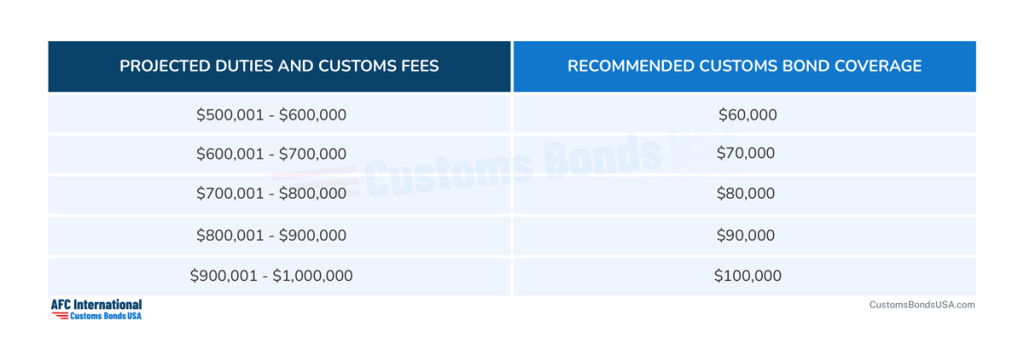
Per CBP guidelines, a continuous customs bond should cover 10% of projected duties and customs fees over a 12-month period. The minimum mandated amount of coverage for a continuous customs bond is $50,000. That’s sufficient for importers who project $500,000 or less in duties and customs fees over 12 months.
CBP recommends importers round up to the nearest $10,000 when estimating duty payments, so if the importer projects duties and fees between $500,001 and $600,000, they’ll need a $60,000 continuous customs bond.
The table below displays recommended customs bond coverage for a series of projected duties owed.
It’s advisable to purchase more coverage than may seem necessary. Tariff increases can raise duties on short notice, resulting in bond insufficiency.
For instance, importers in mid 2025 received notices of bond insufficiency after the application of tariffs put in place under the International Emergency Economic Powers Act (IEEPA) increased duties owed by U.S. importers by billions of dollars in total.
Bond insufficiency can lead to CBP revoking import privileges until a sufficient bond is purchased or collateral is posted.
What Other Bond Types Does CBP Recognize?
Including the basic importation and entry bond, CBP recognizes several other bond types for roles and responsibilities in the U.S. customs clearance and international trade processes. Below are some of the other bond types importers may want to familiarize themselves with.
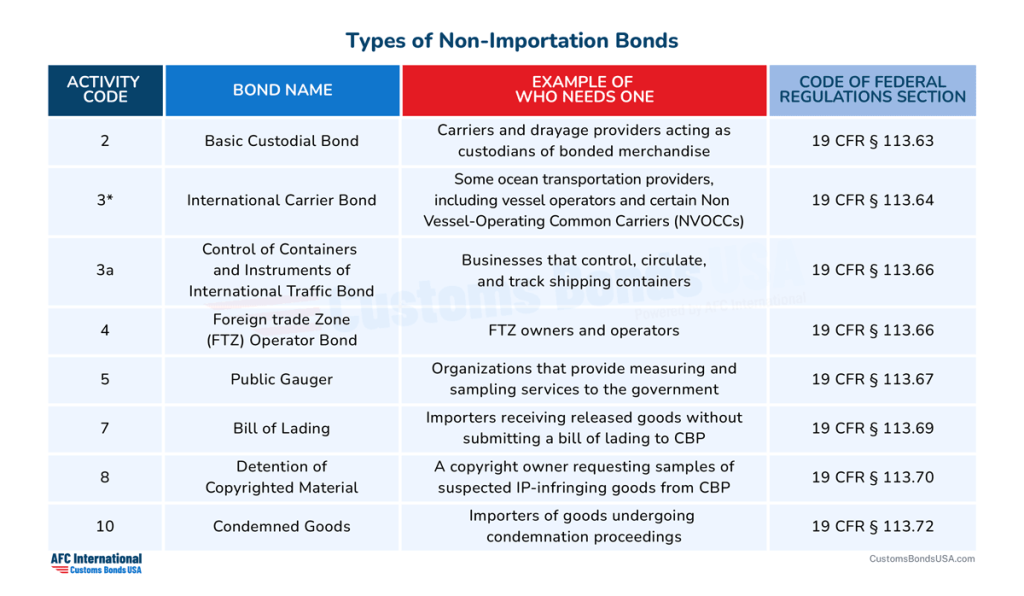
*This bond also fulfills the obligations of activity code 11 and 16 bonds.
Once an importer has determined which customs bond they need, they can move on to the application process.
How Do You Get a Customs Bond?
In most cases, importers purchase customs bonds through Licensed Customs Brokers. The brokers act as agents for surety companies in this capacity. Some large businesses may deal directly with sureties, but these instructions will focus on acquiring an activity code 1 customs bond from a customs broker.
- Choose Single Transaction or Continuous: A continuous bond is ideal for businesses that import frequently, while a single-entry bond can work for four or fewer imports a year.
- Calculate Required Customs Bond Coverage: For a single transaction bond, this is the value of the shipment plus projected duties and customs fees. Continuous bonds should cover 10% of projected duties and customs fees over 12 months ($50,000 minimum).
- Submit Customs Bond Application: After contacting a customs broker, the importer will need to fill out and submit CBP Form 301 per 19 CFR Part 113.
- Approval Process: The surety will need to approve the bond before it can be issued, and the bond application must be filled out accurately before CBP will accept it.
- Bond Issued and Filed: Upon approval, the customs bond is filed with CBP.
If you already know your shipment value, import frequency, and product type, a licensed customs broker can help you choose the right bond amount and file it correctly with CBP.
Contact our team at (480) 725-3433 to get a bond recommendation based on your shipment profile.
Sources
PART 113—CBP BONDS, Code of Federal Regulations (CFR), 2026
Import Security Filing (ISF) – When to submit to CBP, U.S. Customs and Border Protection, 2025
A Guide for the Public: How CBP Sets Bond Amounts, U.S. Customs and Border Protection, February 2024
Customs Bond, Department of Homeland Security U.S. Customs and Border Protection