


Why Your Customs Bond Amount May Be Too High

By Jacob Lee
Last Modified:
June 1st, 2026

Was this article helpful?
Explore even more resources at customsbondsusa.com
Why Is My Customs Bond So High?
Your customs bond amount is usually high because CBP requires enough coverage to match your shipment value, duty exposure, regulatory risk, and prior import activity. Common causes include higher tariffs, partner government agency (PGA)-regulated goods, underestimated duties, and insufficient continuous bond coverage.
CBP determines bond amounts based on the type of bond the importer requires:
- Single Transaction Bond: A single transaction bond is a one-time financial guarantee for a shipment’s import fees.
- Continuous Bond: A continuous bond is an annual financial guarantee for recurring shipments’ import fees in a 12-month period.
We’ve created a chart that illustrates factors that may raise your import duty coverage threshold.
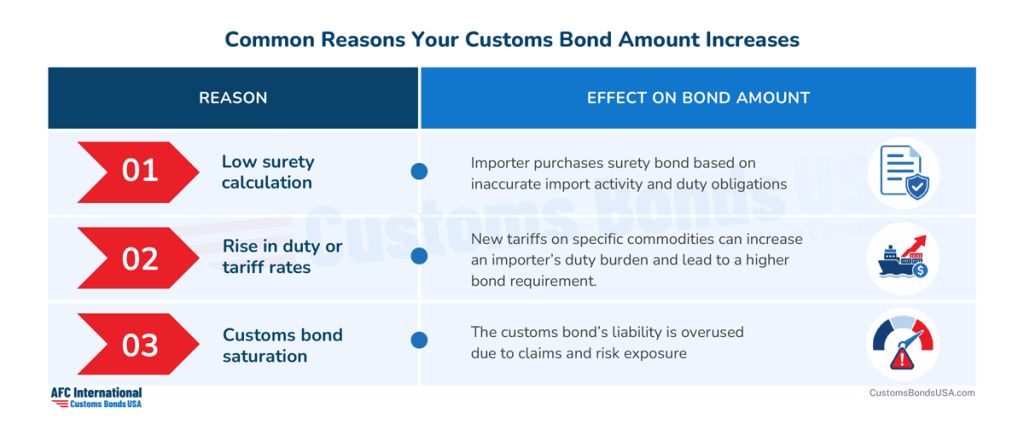
Bond sufficiency refers to whether your bond amount covers your expected duties, taxes, fees, and import volume. Bond saturation refers to how much of that bond capacity has already been used by entries, claims, or other liability exposure.
Sureties determine bond amounts through underwriting that considers total liability exposure. When importers estimate duties, taxes, fees, and shipment volume accurately, they are less likely to carry more bond coverage than they need.
Factors that can increase the required bond amount include:
- Goods with a value over $2,500
- Commodities sourced from countries that are subject to higher tariff rates
- Commodities regulated by PGAs like the Food and Drug Administration (FDA) or Environmental Protection Agency (EPA)
For both single transaction and continuous bonds, these factors can increase the amount of surety coverage required.
How Much Does a Customs Bond Generally Cost?
The cost of a customs bond depends on the bond type, shipment value, duty exposure, and risk level. Single transaction bonds are priced per shipment, while continuous bonds are annual bonds typically based on 10% of an importer’s duties, taxes, and fees.
Single Transaction Bond Cost
Single transaction bond amounts are the total shipment’s value plus import fees, and cannot be less than $100 unless federal law expressly allows it. Bond providers typically charge between $50 to $150 per shipment.
Example: $150 for a Single Transaction Bond
A sports equipment importer is preparing for a single shipment of lawn-tennis balls via truckload from Mexico. The total value of the shipment is $12,000 and the importer will claim preferential treatment under the United States-Mexico-Canada Agreement (USMCA).
This means the importer does not pay duties or tariffs, but must pay commercial shipment fees and the single transaction bond rate as the shipment is valued over $2,500. The importer works with a customs broker to obtain the bond and the broker charges a single transaction bond fee of $150 to underwrite the surety for their bond.
Continuous Bond Cost
Continuous bond amounts are a minimum of $50,000 or 10% of an importer’s duties, taxes, and fees paid in the previous 12-month period. Continuous bonds cost between $300 to $600 depending on the import volume and risk exposure.
Example: $600 for a Continuous Bond
A cosmetics importer ships lipsticks from Indonesia valued at $5,000 per shipment. The importer ships four times a year. The importer must include the appropriate duties, taxes, and fees in their bond which they obtain through a broker.
The broker charges $600 as lipstick is subject to additional compliance regulations from FDA under the Modernization of Cosmetics Regulation Act of 2022 (MoCRA).
In this example, the importer may underestimate their import volume should their shipments increase from four to six times a year.
The existing bond amount may become insufficient, requiring the importer to either obtain a single transaction bond for each additional shipment or increase the continuous bond amount to cover the updated duties, taxes, and fees.
Can You Lower Your Bond Amount If It’s Too High?
Yes, importers may lower a customs bond amount when import volume, duties, or overall exposure decreases. However, the revised amount must still meet CBP minimum requirements and receive approval through the proper bond amendment or replacement process.
The new bond amount cannot be:
- Less than $100 for single transaction bonds
- Less than $50,000 for continuous bonds
CBP allows importers to adjust their bond amount in two ways:
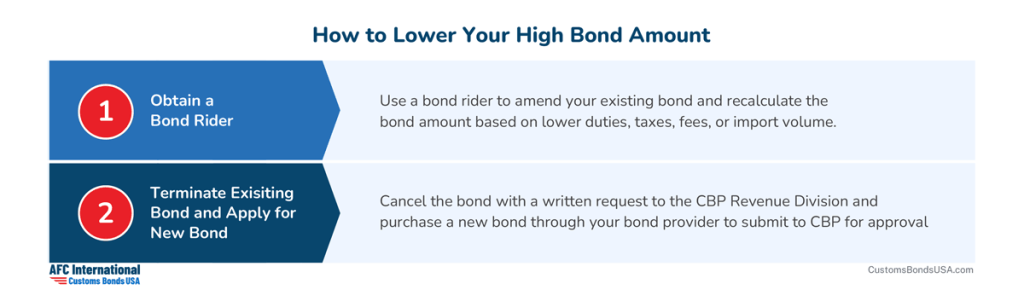
CBP allows bond terminations to take effect on the importer’s termination date request as long as that date is 10 business days after CBP has received the request. However, it’s best to refer to a customs broker to verify if your bond type has termination contingencies, like outstanding claims or other unresolved liability issues.
According to 19 CFR 113.3, importers are still liable for any obligations on the previous bond even if they’ve applied and are approved for a new bond.
Common Bond Amount Mistakes
Importers commonly make bond amount mistakes by:
- Miscalculating estimated taxes, fees, and duties
- Purchasing insufficient surety bond
- Underestimating expected import volume during the year
While importers can correct these mistakes on their own, working with a customs broker helps ensure the information is accurate, allowing them to secure the correct bond amount while controlling import costs and maintaining compliance with federal regulations.
What Happens If Your Customs Bond Is Too Low or Too High?
If a customs bond is too low, CBP may require the importer to increase coverage to remain compliant. If the bond is too high, the importer may pay for more coverage than needed, but there is generally no direct federal penalty.
Importers who do not purchase a higher bond amount to maintain compliance risk CBP cargo holds, supply chain disruptions, or revoked importer privileges for neglected claims.
When a bond amount is too high, importers risk commercial consequences such as purchasing unnecessarily expensive bond premiums for unneeded coverage. There is no federal consequence for a high bond amount.
CBP Refunds
Importers may be eligible for a refund through CBP’s ACH enrollment for overpayment of import fees on liquidated goods, but CBP does not offer refunds for customs bonds.
Customs bonds are not pre-paid duties, taxes, and fees but insurance purchased through a surety to use in the event importers do not pay the import fees owed to clear customs.
Overestimated bond amounts are not credited to an importer’s next shipment. Every new shipment valued over $2,500 requires a bond to guarantee payment of duties, taxes, and fees to CBP.
If your customs bond amount seems too high, compare your current coverage with your actual shipment value, annual duties, and compliance exposure before renewing. Call our team at (480)-725-3433 to learn how to reduce insufficiency risk before CBP flags the bond amount.
Sources:
Bonds – How are Continuous and Single Entry bond amounts determined?, CBP
About USMCA, CBP
Modernization of Cosmetics Regulation Act of 2022 (MoCRA), FDA
19 CFR 113.3 – Liability of surety on a terminated bond.
Terminating a Customs Bond, CBP
ACH Refund, CBP