



By Joe Weaver
Last Modified:
May 20, 2026

Was this article helpful?
Explore even more resources at customsbondsusa.com
Who Needs a Customs Bond?
Most importers need a customs bond when a shipment requires formal entry. That usually includes commercial shipments valued at $2,500 or more, goods regulated by a Partner Government Agency (PGA), and some imports with AD/CVD exposure. The bond guarantees that U.S. Customs and Border Protection (CBP) can collect duties, taxes, and fees owed on the entry.
When Is a Customs Bond Required for Importing?
Under 19 CFR Part 113, importers generally need a customs bond when a shipment requires formal customs entry. In practice, that often includes commercial shipments valued at $2,500 or more, goods regulated by a PGA, and some transactions involving special duty exposure such as antidumping/countervailing duties (AD/CVDs).
- The total value of products in the shipment is $2,500 or more
- The goods in the shipment are regulated by a PGA
- The merchandise is subject to AD/CVDs or a trade agreement
Let’s look closely at the nuances of these requirements.
Commercial Shipments Valued at $2,500 or More
Most commercial importers will easily meet the >$2,500 shipment valuation rule when bringing goods into the U.S. That threshold alone generally means the importer must have a bond on file with CBP.
Importers should keep in mind that the customs bond valuation requirement is based on the price paid by the importer, not the retail value. So, if a business imported 1,000 cell phones for which they paid $100 a piece and the retail value is $300 a piece, valuation is taken from the $100 value: therefore, the shipment value is $100,000, not $300,000.
How PGA-Regulated Goods Trigger Bond Requirements
Even below the $2,500 threshold, PGA-regulated goods may still require a bond on file before entry. The table we’ve provided lists some PGAs and the goods they regulate that may require a customs bond.
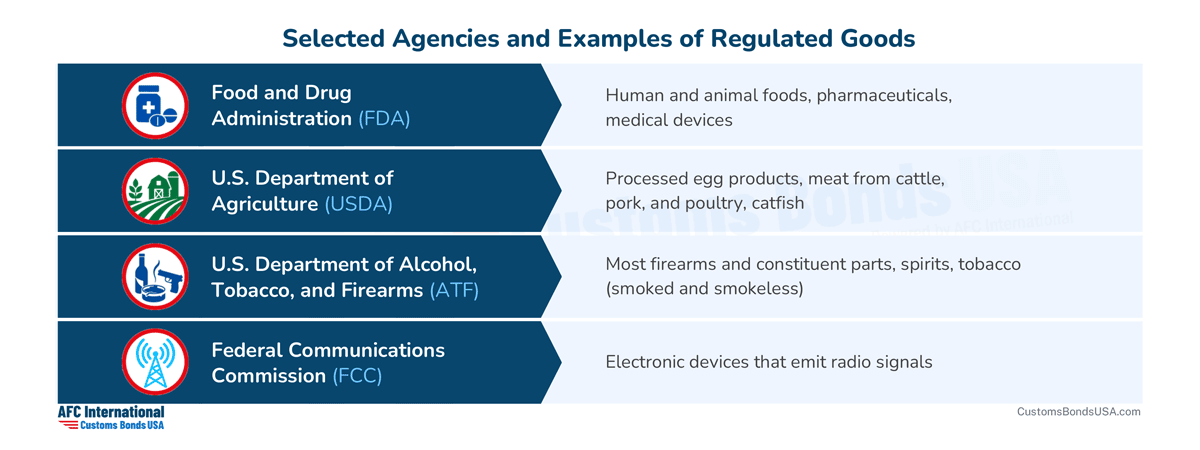
An example of this customs bond requirement in practice occurred when an importer called us because he had a rifle stock stuck in U.S. Customs. Even though the stock was valued under $2,500, it was still regulated by the ATF and required the importer to have a customs bond.
How AD/CVD Orders Can Affect Customs Bond Requirements
AD/CVDs are additional duties assessed by the International Trade Administration (ITA) on goods imported from certain countries and business entities. If an entry involves AD/CVD exposure and the required bond is not on file, the shipment may be delayed or prevented from clearing until the requirement is met.
Some import transactions involving special duty treatment or compliance requirements may still require a customs bond, even when a trade agreement reduces or eliminates duties. Importers should confirm bond requirements based on entry type, agency requirements, and the specific treatment claimed for the shipment.
Whether the need for a bond is triggered by shipment valuation, PGA involvement, or AD/CVD and trade agreement involvement, importers who need a customs bond usually have to choose between a single transaction bond (STB) and a continuous bond.
What Is a Formal Entry and Why Does It Matter for Customs Bonds?
CBP generally requires a customs bond when a shipment is entered as a formal entry. For commercial imports, that includes shipments valued at $2,500 or more, as well as certain lower-value shipments regulated by PGAs or subject to special duty rules related to tariffs or trade agreements.
What Types of Customs Bonds Do Importers Need?
To clear an imported formal shipment through U.S. customs, an importer will need one of two types of customs bonds:
- Single Transaction Bond: As the name implies, an STB ensures payment of duties for one imported shipment. The importer must designate a specific port at which the bond can be used.
- Continuous Bond: Any commercial importer bringing four or more formal shipments into the U.S. over a 12-month period should get a continuous customs bond. A continuous bond provides at least $50,000 in coverage, remains active for 12 months, and can be used at any U.S. port.
The following scenarios illustrate when an STB makes the most sense for an importer and when a continuous customs bond is the better choice.
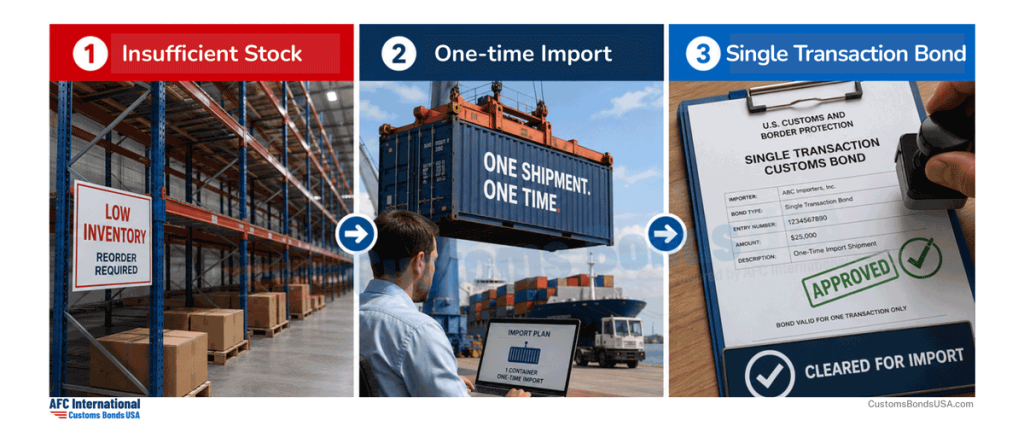
Scenario 1: A single transaction bond for a one-time import.
A U.S. business owner’s domestic supplier is temporarily out of stock. To avoid running out of inventory, the owner places a one-time $3,000 order with a foreign supplier for replacement merchandise.
In this situation, an STB usually makes more sense because the shipment is a one-off import rather than part of an ongoing importing strategy.
Scenario 2: A continuous bond for recurring monthly imports.
Later, the same business owner expands the business and decides to place a monthly stocking order with that same foreign supplier. At that point, a continuous customs bond is the better fit because the company is consistently importing high-value shipments.
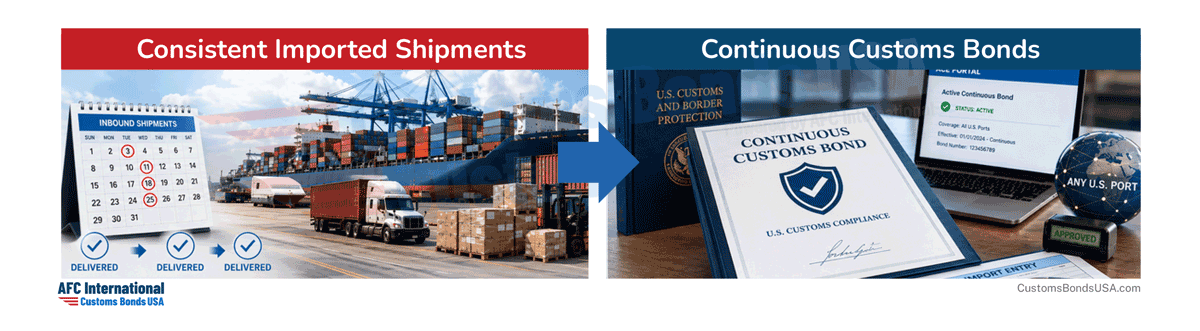
Continuous and single transactions are the two types of customs bonds with which commercial importers need to be the most familiar. There are several other bond types required for international carriers, Foreign Trade Zone (FTZ) operators, and other roles in the international trade and logistics industries.
How Much Customs Bond Coverage Do You Need?
A continuous customs bond must be sufficient to cover up to 10% of an importer’s projected duties and customs fees over a 12-month period. Importers can estimate this value based on historical sales data or future sales projections.
CBP sets the minimum amount of coverage for a continuous customs bond at $50,000. This is 10% of $500,000, so if an importer’s duties and custom fee payments over 12 months are $500,000 or less, a $50,000 customs bond will be sufficient.
An STB should cover the value of the shipment in addition to customs fees and duties. No STB should have a coverage value of under $100.
For every additional $100,000 in projected duty payments, CBP recommends an additional $10,000 worth of continuous customs bond coverage, rounding up to the nearest $10,000. Doing so helps importers avoid bond insufficiency.
What Is Bond Insufficiency?
Bond insufficiency is the result of an importer purchasing a customs bond that does not have adequate coverage to meet CBP’s 10% estimated duties and fees rule. CBP periodically reviews customs bonds and, if they determine that an importer’s customs bond is insufficient to meet the established threshold, the agency can take measures such as preventing the importer from bringing goods into the country until they secure a sufficient bond or post collateral.
Even well-prepared importers can run into bond insufficiency when duty exposure rises quickly, such as during tariff changes.
What Happens if I Import Without a Customs Bond?
At the very least, trying to import goods that require a customs bond without a bond on file will lead to a delay at customs clearance. Our Licensed Customs Brokers have helped more than one inexperienced importer who had a shipment stuck in customs because they didn’t know they needed a customs bond.
Depending on the shipment and the violation, importing without a required bond can also lead to consequences such as:
- Seizure and destruction of imported goods
- Greater scrutiny from CBP on future import transactions
- Damage to business reputation resulting from penalties
You likely need a customs bond if your shipment is worth $2,500 or more, your goods are regulated by a PGA, or your import is affected by special duty rules such as AD/CVD. If you import only once, a single-entry bond may be enough. If you import regularly, a continuous bond is often the better fit.
Not sure whether your shipment needs a bond? Call our team at (480) 725-3433 to find out.
Sources:
Title 19, Chapter I, Part 113, Code of Federal Regulations, 2026
U.S. Antidumping & Countervailing Duties, International Trade Administration
AD/CVD Proceedings, International Trade Administration
Bonds – How Are Continuous and Single Entry Bond Amounts Determined, 2026