

Why Your Customs Bond is Insufficient



Written by Joe Weaver
Last Modified: May 29, 2026

Was this article helpful?
Explore even more resources at customsbondsusa.com
What Does It Mean When a Customs Bond Is Insufficient?
Customs bond insufficiency is a status in which CBP determines that a continuous customs bond no longer provides adequate or compliant coverage due to issues like unpaid debt, missing paperwork, invalid importer information, or invalid addresses.
A notable example of bond insufficiency affected multiple importers in 2025, as rising tariffs increased customs bond coverage requirements by up to 550% in some cases.
Why Does CBP Mark a Customs Bond Insufficient?
CBP determines customs bond sufficiency by reviewing whether the bond still covers the importer’s expected duties, taxes, fees, and compliance obligations. A bond may become insufficient when debt, invalid importer data, missing paperwork, or higher tariff exposure increases the importer’s financial risk.
CBP assesses customs bond sufficiency based on the following factors:
- Whether an entity on the customs bond has an issue with debt such as unpaid customs fees
- How quickly an importer responds to a CBP request for a bond increase
- If the address on the customs bond is valid
- Availability of bond paperwork
- Accuracy of IOR number used on the bond
- The importer’s compliance with additional paperwork requests related to the customs bond
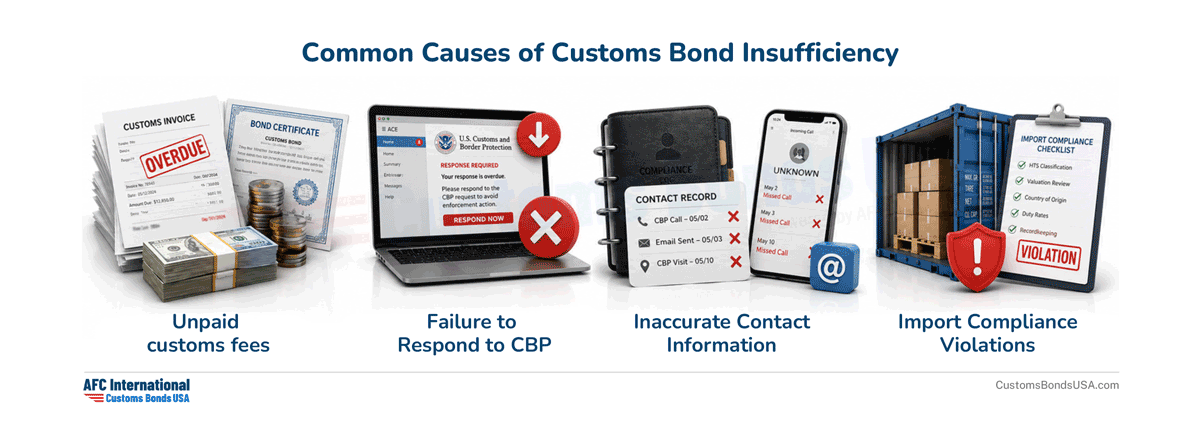
CBP may offer any affected parties 30 days to correct an insufficiency scenario, though the agency also reserves the right to terminate an insufficient continuous bond without notice.
Bond Insufficiency Scenarios
The following scenarios show how tariff changes can make a customs bond insufficient and force an importer to increase coverage.
Section 301 Tariff Increase
A seasoned importer has three years worth of sales from which to draw projections, and calculates that he will need a $60,000 bond to cover approximately $600,000 worth of duties on golf shoes imported from Thailand. These shoes are categorized under HTS code 6402.19.0530 and carry a 6% duty rate. They are also subject to the 10% Section 122 tariff, so the importer calculates his projections based on a combined rate of 16%.
However, four months later, a Section 301 investigation concluded against Thailand resulting in a 20% tariff being applied which replaced the lower 10% Section 122 tariff. This raises the effective tariff rate on shoes imported from Thailand to 26%.
The additional 10% pushes the importer’s projected duties and customs fees over the $600,000 mark. As a result, the customs bond becomes insufficient, and CBP may notify the importer upon review and require the bond’s limit be increased.
International Emergency Economic Powers Act (IEEPA)
In 2025, the imposition of Liberation Day tariffs via the IEEPA raised tariffs on a per-country basis, starting at 10% and going into triple-digit effective tariff rates in some cases. These tariffs caused bond insufficiencies that required some businesses to increase their coverage by up to 15x their previous amount.
This issue was exacerbated by tariff stacking, a phenomenon in which IEEPA, Section 301, and most favored nations duties could all apply to a single commodity. Importers caught unprepared found themselves unable to have their shipments released until they purchased sufficient customs bonds and/or posted the collateral required for bonds that exceed $100,000 in coverage.
IEEPA tariff increases, while now overturned by the supreme court, are a classic example of how unexpected changes in trade policy can rapidly lead to bond insufficiency.
What Are the Penalties for Having an Insufficient Customs Bond?
According to CBP, an importer can potentially experience the following consequences as a result of customs bond insufficiency:
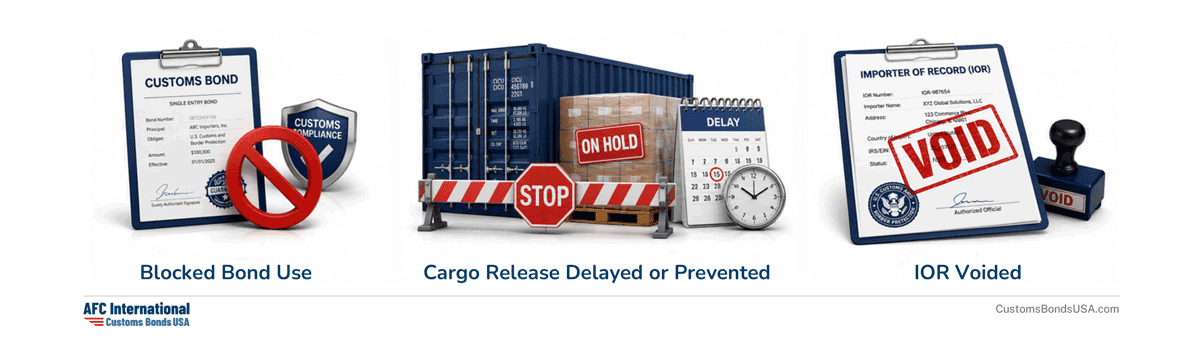
Fortunately, avoiding customs bond insufficiency just requires basic proactive strategies on the part of importers.
How Do You Fix an Insufficient Customs Bond?
To fix an insufficient customs bond, the importer usually needs to identify the cause, correct any invalid importer or address information, resolve outstanding debt, respond to CBP requests, and increase the bond amount when duty exposure has grown beyond the current bond limit.
Concerned about the possibility of bond insufficiency? Call our team of experienced U.S. Customs brokers at (480)-725-3433 to ensure you have sufficient customs bond coverage for your imported shipments.
Sources:
Insufficient Bond Information, U.S. Customs and Border Protection, updated March 3, 2011
President Trump’s tariffs fueled U.S. Customs bond market boom. Now billions hang on Supreme Court ruling, Lori Ann LaRocco, February 6, 2026
US importers scramble to manage huge hike in bond outlay linked to higher tariffs, Eric Johnson, July 30, 2025